10 Things to Do in Baden-Württemberg: Castles, Spas, Wine and the Black Forest
A practical top ten for Baden-Württemberg, with castles, spas, small towns, car museums, a Stuttgart wine walk and the Feldbergsteig. Includes the closures and access changes that matter.
Published
September 26, 2026
Updated
September 26, 2026
Destination
Europe · Germany
Baden-Württemberg is easy to overlook beside Bavaria. It may have fewer famous cities, but its charm is everywhere: Heidelberg’s castle, Baden-Baden’s thermal baths, lively university towns, vineyards and trails through the Black Forest.
These ten places work as separate weekend trips or as the basis of a longer journey through southwest Germany. They do not fit comfortably into one weekend: choose a region, then give the smaller towns time to be more than photo stops.
1. 🏰 Heidelberg: Castle Views and a Cruise on the Neckar
Heidelberg Castle deserves a real place in the day rather than serving only as a backdrop for a photo. The terraces look down over the Neckar and the old town, while the courtyard, Great Tun and German Apothecary Museum give you reasons to stay. The current Palace Ticket (Sept 2026) costs €11 for an adult and includes the lower funicular ride to the castle; guided tours cost extra.
Afterward, wander through the Altstadt to the Old Bridge. A boat tour on the Neckar lets you see the bridge, castle and riverside from another angle. Choose a short sightseeing cruise if you have around an hour, or a longer trip into the Neckar Valley if you want to make an afternoon of it.
If you still want another viewpoint, cross the river for the Philosophenweg, but leave enough daylight and energy for the climb. With the castle, old town and a short cruise, Heidelberg is a comfortable full day.
2. ♨️ Baden-Baden: Choose the Bath That Suits You
Baden-Baden is famous for its spas, but its two best-known baths offer quite different experiences. Caracalla Therme is the one to choose if you want to move between indoor and outdoor thermal pools at your own pace. As of September 2026, admission to the pool area costs €21 for two hours, €25 for three hours or €35 for the day. If you also want the separate sauna area, tickets costs €5 more.The sauna area is textile-free: you can sauna naked or wrapped in a towel, but swimwear is not allowed.
Friedrichsbad feels more like a bathing ritual than a pool visit. You follow a Roman-Irish circuit through warm rooms, steam and baths inside a historic building. Admission is €39 as of September 2026, with towels and bathing shoes included; allow around three hours to complete the circuit. One detail to know before choosing: bathing suits are required on Wednesdays and Saturdays, while the other days are traditionally without them.
Make the climb up Freiburg’s cathedral tower the centrepiece of your visit. As of September 2026, an adult ticket costs €5. There are 209 steps to the tower keeper’s room, followed by more stairs to the viewing galleries. From above, you can look over the old town and, on a clear day, towards the Kaiserstuhl, Vosges and Black Forest. The climb is steep and unsuitable for visitors with limited mobility; the highest gallery may close when there is snow or ice.
Back at street level, take your time around Münsterplatz and follow the little Bächle channels through the old town. Freiburg is worth a day of its own and makes a convenient base for exploring the southern Black Forest.
4. 🎢 Europa-Park: Give Rust a Whole Day
Europa-Park needs its own day. If you love roller coasters, put Voltron Nevera near the top of your list for its repeated launches, then choose between the height and speed of Silver Star, the inversions of blue fire, and the rattling rush of the wooden WODAN. You will probably have to prioritise: trying to ride every major coaster can turn the day into a race between queues.
There is plenty to enjoy if intense rides are not your thing. ARTHUR combines a family coaster with a journey through a fantasy world; Pirates in Batavia is a detailed indoor boat ride; and Voletarium gives you the sensation of flying across Europe. Leave some time to wander between the park’s themed areas rather than treating the paths as shortcuts between rides.
Before you go, check the official season calendar and use the park app for live wait times and VirtualLine reservations on selected attractions. Opening dates, hours and ticket prices vary. You do not need a car just for the park: take a train to Ringsheim/Europa-Park station, then the connecting bus to the resort.
5. 🚗 Stuttgart: Compare Two Very Different Car Museums
Stuttgart earns its place through two museums that tell different sides of car history. At the Mercedes-Benz Museum, the route begins with the invention of the automobile and follows its development through historic vehicles, design and motorsport. The Porsche Museum is a more focused visit, with sports cars, racing machines and prototypes in Zuffenhausen, where Porsche has its roots. As of September 2026, regular adult admission is €16 at Mercedes-Benz and €15 at Porsche. Keep your Mercedes-Benz ticket: Porsche lists a 25% discount on its admission when you present it.
The museums are in different parts of Stuttgart, so allow time to travel between them. Both normally open Tuesday to Sunday; check their calendars for holiday changes. If cars are the main reason for your visit, give the museums most of the day.
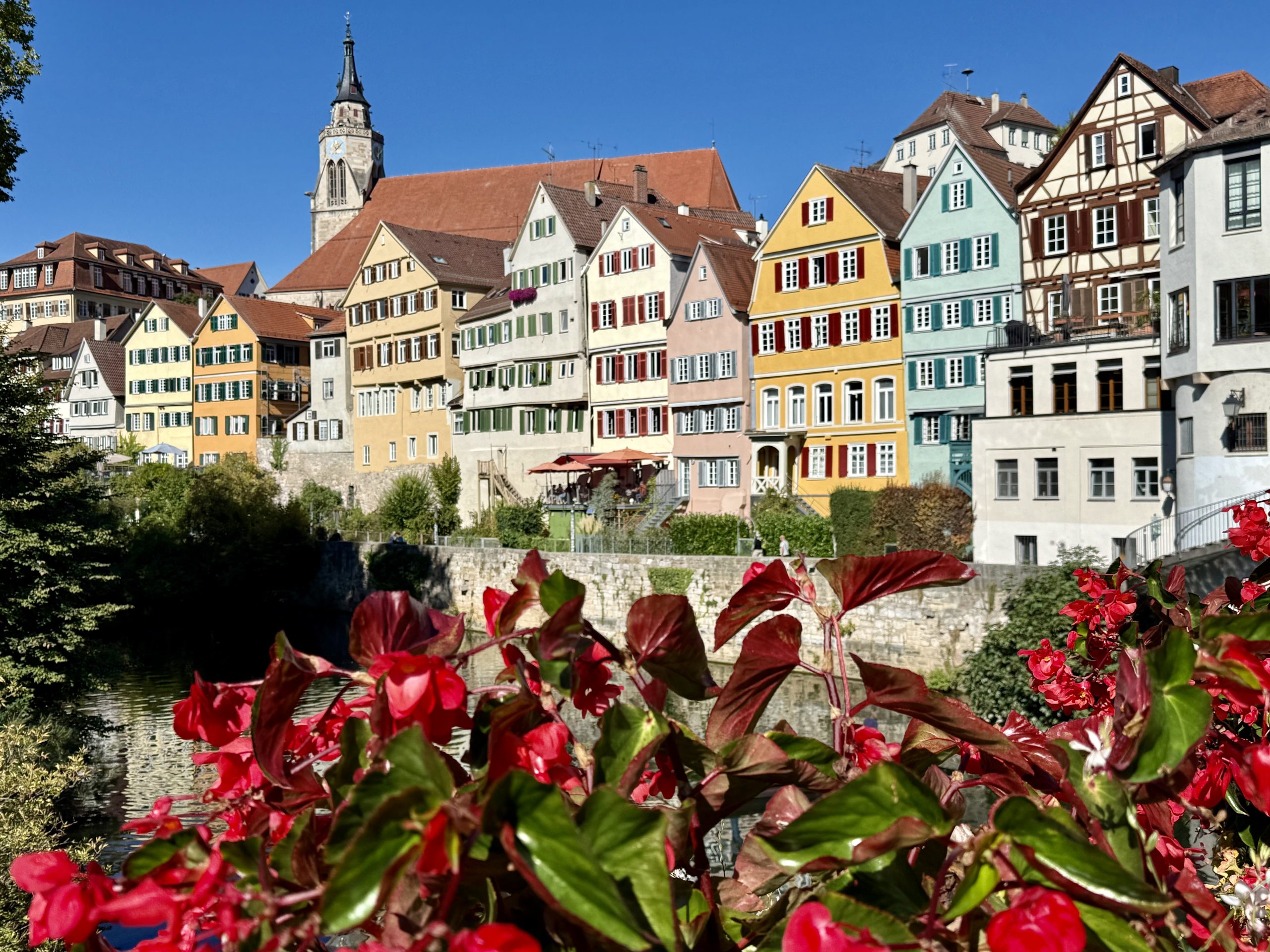
Tübingen works best on foot. Start at the Neckarbrücke for the riverfront view, then head into the old town instead of staying at the postcard viewpoint. Its sloping streets and squares reward an unhurried half-day, and a traditional Stocherkahn punt offers another way to see the Neckar when trips are running.
A Stocherkahn ride is optional, but it is a lovely way to see Tübingen’s Neckarfront from the water. Public rides organised by Tübingen Tourism depart from the Casino landing stage at Wöhrdstraße 25, about 200 metres from the tourist information office by the Neckar bridge. Check the current departures and book here, as other operators may use different boarding points. Tübingen also makes a good outing from Stuttgart when you want a slower day of wandering through the old town.
7. 🏛️ Karlsruhe and Ettlingen: A Palace View and a Smaller Old Town
Karlsruhe’s palace remains the city’s visual centre, with streets radiating out from it. There is a crucial update for planning, though: the Badisches Landesmuseum inside the palace, the palace tower and its café are closed for renovation. The closure began on 29 September 2025 and is expected to last several years; no firm reopening date has been announced. See the palace from outside and plan a city walk.
Continue to Ettlingen for a smaller old town with a different pace. The city has a self-guided historic walk, giving you a reason to wander rather than simply tick off another castle. Ettlingen pairs geographically with Karlsruhe. Esslingen, despite the similar name, belongs with Stuttgart.
8. 🍷 Walk Through Stuttgart’s Vineyards and Taste the Local Wine
For a wine experience, I would stay close to Stuttgart and walk through the vineyards above the Neckar. Start at Obertürkheim station, where the signposted Obertürkheim–Uhlbach–Rotenberg–Untertürkheim wine trail begins. The full route is 10.7 km, with some steep climbs; Stuttgart Tourism estimates three hours of walking, so allow at least half a day once you add stops. Download its GPX route before setting off.
Your first useful stop is Uhlbach. The Vinothek inside the Stuttgart Wine Museum, at Uhlbacher Platz 4, serves wines from local producers. You can order a glass or try its self-guided tasting without booking; a guided tasting needs advance arrangement. Check its opening hours when planning your walk, especially if you are going on a weekday.
From Uhlbach, continue through the vineyards towards Rotenberg and follow the signs for the hilltop Grabkapelle if you want the extra viewpoint. You can then finish the walk towards Untertürkheim station. For a shorter outing, stop in Uhlbach and take bus 62 back to Obertürkheim, or continue to Rotenberg and take bus 61 to Untertürkheim. That way, you can enjoy the wine and views without committing to the entire loop.
Hidden gem: Esslingen am Neckar. Walk past the half-timbered houses and the Old Town Hall, then head towards the canals of “Little Venice.” If you have more time and energy, climb to the Esslinger Burg for a view over the rooftops and vineyards. Despite its name, it was part of the town fortifications rather than a castle where anyone lived. To enjoy Esslingen at an unhurried pace, give it a separate half-day.
9. 🥾 Black Forest: Hike the Feldbergsteig
If you want one proper hiking day in the Black Forest, I would choose the Feldbergsteig. It gives you open views around the Feldberg summit, a string of mountain huts and, later, the quieter setting of the Feldsee. The official circular route is 12.4 km with 502 m of ascent, rated hard, and takes about five hours of walking. Add time for a hut stop, photos and the journey there and back.
Where to start: The trail begins behind the Haus der Natur in Feldberg-Ort and climbs towards the panorama path. It continues past the Feldberg tower and summit, descends by the mountain huts and Raimartihof, then passes the Feldsee before climbing back to the start. Without a car, take the train to Titisee and bus 7300 to Feldberger Hof, a short walk from the trailhead. Check the return bus before you set off.
The narrow paths and small bridges call for sturdy shoes and confident footing. Download the route for offline navigation, carry water and an extra layer, and check conditions that morning. The Feldbergsteig is not passable from November through April; during those months, choose one of the designated winter walking routes instead. Even in the hiking season, change plans if the paths are icy or visibility is poor. Swimming in the protected Feldsee is prohibited. For what to carry, see my one-day hiking packing checklist.
10. ⛪ Ulm: The Münster and the Fishermen’s Quarter
Ulm is worth visiting for the Münster, but leave time to walk down toward the Fischerviertel and the Danube. Its 161.53-metre spire is Germany’s tallest church tower.
The spire’s height is also different from how high visitors can currently climb. During the present renovation, the tower ascent reaches the second platform rather than the top, and part of the nave has restricted access. Check the live visitor notice before planning your day around the climb. Ulm’s old streets and riverfront still make a satisfying final stop if you decide against the stairs.
🚆 How to Get Around Baden-Württemberg
You can reach most of these stops without a car. Regional trains connect the cities, with local buses covering the final stretch to places such as Europa-Park and the Feldberg trailhead. For Europa-Park, travel to Ringsheim/Europa-Park station and take the resort bus. For the Feldbergsteig, travel via Titisee and take bus 7300 to Feldberger Hof. Check the last return connection before committing to a full day out.
If you plan several public transport days in the same calendar month, consider the Deutschlandticket. As of September 2026, it costs €63 per month and covers regional trains, S-Bahn, trams and buses throughout Germany. It is a subscription that you can cancel monthly; to end it at the close of a month, cancel by the 10th of that month. It does not cover ICE, IC or EC trains, so check the train type when choosing a connection.
For just a few journeys, CiCoBW may be simpler. It works through apps such as bwegt, VVS BWeit and FAIRTIQ: check in before travelling and check out at your destination, and the app calculates the fare. It needs no subscription and covers local and regional transport across Baden-Württemberg. As of September 2026, its second-class charges are capped at €72 per calendar month. If you expect to travel enough to reach that cap, the €63 Deutschlandticket is usually the better buy, but be aware of cancellation deadlines.
A car is useful for flexibility, particularly if you want an early hiking start, several small Black Forest villages in one day, or stops beyond the main rail and bus routes.
🏨 Where to Stay in Baden-Württemberg
I would choose accommodation based on the places you plan to visit, rather than book one hotel for all ten stops. Stuttgart is a practical base for the car museums, Esslingen, the vineyard walk and a day trip to Tübingen. Freiburg works better for the southern Black Forest and the Feldberg hike, while Heidelberg or Baden-Baden makes sense if you are concentrating on the north of the state.
If Europa-Park is your main reason for travelling, staying in Rust lets you start the park day without an early journey. For a longer trip across Baden-Württemberg, I would split the nights between two areas. Check the distance from your hotel to the station if you are using regional trains, or parking arrangements if you are driving.
Find a place to stay
?
FAQ: Visiting Baden-Württemberg
Pinterest
Save this guide for later
Planning your trip? Save these pins for easy reference.
Written by
Travelisse
Travel writer · Photographer · Founder of Travelisse
Travelisse founder, travel writer, and photographer sharing practical guidance built from firsthand experience.